
Meet him
He raised both armies.
He loves the five. He fights for the hundred. Both sides bow to him before trying to bring him down. He is the oldest warrior on the field — he was there before you were you.
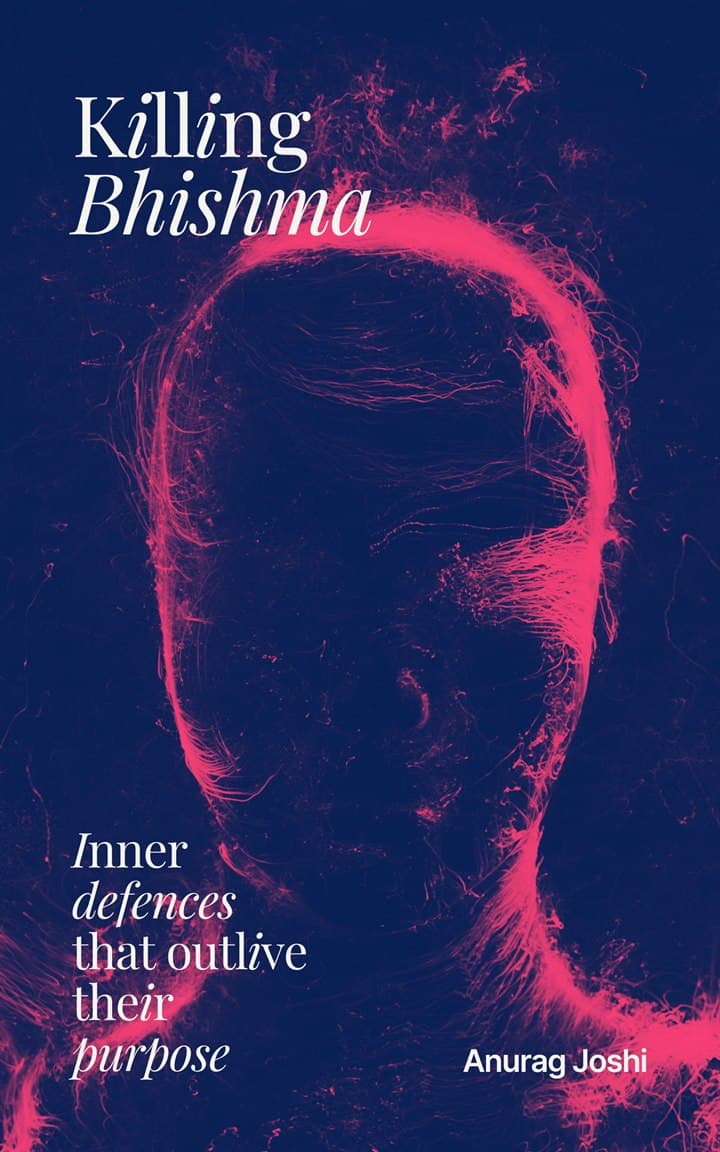
Inner defences that outlive their purpose
A book by Anurag Joshi
Inner defences that outlive their purpose
For the one who fights a war every single day — and has never once called it a war.
Eighteen chaptersOne field2026
Chapter I — The Field
YoualreadyknowtheMahabharata.
Thecousins.Thedice.Theeighteendays.Astorythatwentbackontheshelf.
Itisnottherecordofawarthathappenedonce.
Itisthereportofawarthatishappeningnow.
धर्मक्षेत्रे कुरुक्षेत्रे
Dharmakshetre Kurukshetre — Bhagavad Gita 1.1
The field is not a place near Delhi. The field is the body. Yours.
Chapter II — The Two Armies
The sages were not exaggerating. They were counting.
The muster roll
the blind king, awake at two
The replay you did not order — the argument again, tonight, with the better line you never said.
The Gita opens at your bedtime. You have been living its first verse all your life.
The muster roll
the one who is hard to fight
The wanting that has crowned itself king — the part of you that would rather burn the whole kingdom than share an inch of it.
You have heard his voice. Usually somewhere near the word “sorry.”
The muster roll
the one who is hard to restrain
The hand that has already reached before the mind has finished asking.
The phone was open before you chose to open it.
The muster roll
the uncle with the dice
He does not attack you. He deals you a game that feels fair — just one more, from Monday, one last time.
The game always feels fair. The dice are always his.
The muster roll
the teacher who trained both sides
The discipline that holds your diet on Monday holds your scrolling at midnight — with equal devotion.
You were not out-argued. You were out-trained.
The muster roll
the brother on the wrong side
The talent that overworks — not to build anything, but to prove something to a schoolteacher who is not even alive.
What he needed was not a crown. It was a witness.
A hundred and one on one side.
Five on the other.
And at the centre of the field —
a grandfather.
Keep scrolling — the roll is long
Chapter III — The Grandfather
Meet him
He loves the five. He fights for the hundred. Both sides bow to him before trying to bring him down. He is the oldest warrior on the field — he was there before you were you.
The vow
Some young version of you swore something, in love or in fear — never be seen failing, never need anyone, never want what can be taken away. And it worked. On that day, the vow was heroic.
The wall
He still stands there — old, loyal, decorated — stopping the very things you now want to let in. Rest was never in the vow. Receiving was not in it either.
The mistake
Fight him, lose, call yourself weak, fight again. But the will you raise against him was trained on his own tracks. Sending willpower against Bhishma is sending his grandson to arrest him.
The reversal
The oldest force in you is not your enemy. It is bound, it knows it is bound — and somewhere inside the armour, it is waiting for you to win a war it cannot stop fighting.
Chapter IV — The Boon
The boon
Ichcha-mrityu — death only by his own wish. The oldest warrior on the field would fall on the day he decided to fall, and not one moment before. No warrior. No army. No god.
Your war record
The diet that quietly died in February. The alarm moved from five to seven. The promise you made yourself on your last birthday. And the birthday before that.
The only question
Millions fight, fail, buy the next book, and fight again — without once stopping to ask it. But you are still here. Half a field deep. Still asking.
The tenth morning
For nine days the finest warriors alive threw everything they had at one old man, and lost. On the tenth morning, he lay down on a bed of arrows. He was not defeated. He chose.
The Tenth Morning
Nine days, nothing touched him. On the tenth morning he lay down — and lived, and taught, and chose his hour.
The answer is not on this page. It is walked to — slowly, an evening at a time — through eighteen chapters of a story you thought you knew.
No seven steps · No morning routine · No twenty-one days
It was never mine to welcome you to.
It was always yours.